

Introducing HeyBrain: the launch announcement
Contents


Introducing HeyBrain
The original HeyBrain launch
Editorial note: This is the launch article originally dated September 23, 2026 and credited to Jayson Burgess. HeyBrain Editorial Team has revised it with AI assistance to distinguish the historical announcement from current product availability. The original author has not been represented as reviewing or approving this revision. The date and launch screenshots are retained.
HeyBrain addresses a practical frustration: teams can use capable AI tools and still spend each conversation rebuilding the context those tools need. A product decision lives in one document, the reason for it in another, and a colleague’s useful answer in a separate chat.
HeyBrain brings company knowledge into a shared workspace for people and AI agents.
The problem behind the launch
Consider a teammate preparing a project update. The latest plan says a release is delayed, but an older slide still gives the original date. Another teammate knows why the date changed. Copying the slide into an AI chat may produce a polished update that is already wrong.
A shared source of context can make the relevant decision easier to find and reuse. It does not remove the need to identify the current decision, retain its source, or distinguish an approved change from a suggestion. More material is useful only when the next person can understand what it means.
The launch article described the team’s own use of shared context across documents, decisions, research and engineering work. That is the supplied author’s historical account, not a new independently measured result or a promise that every customer will follow the same workflow.
What the launch showed
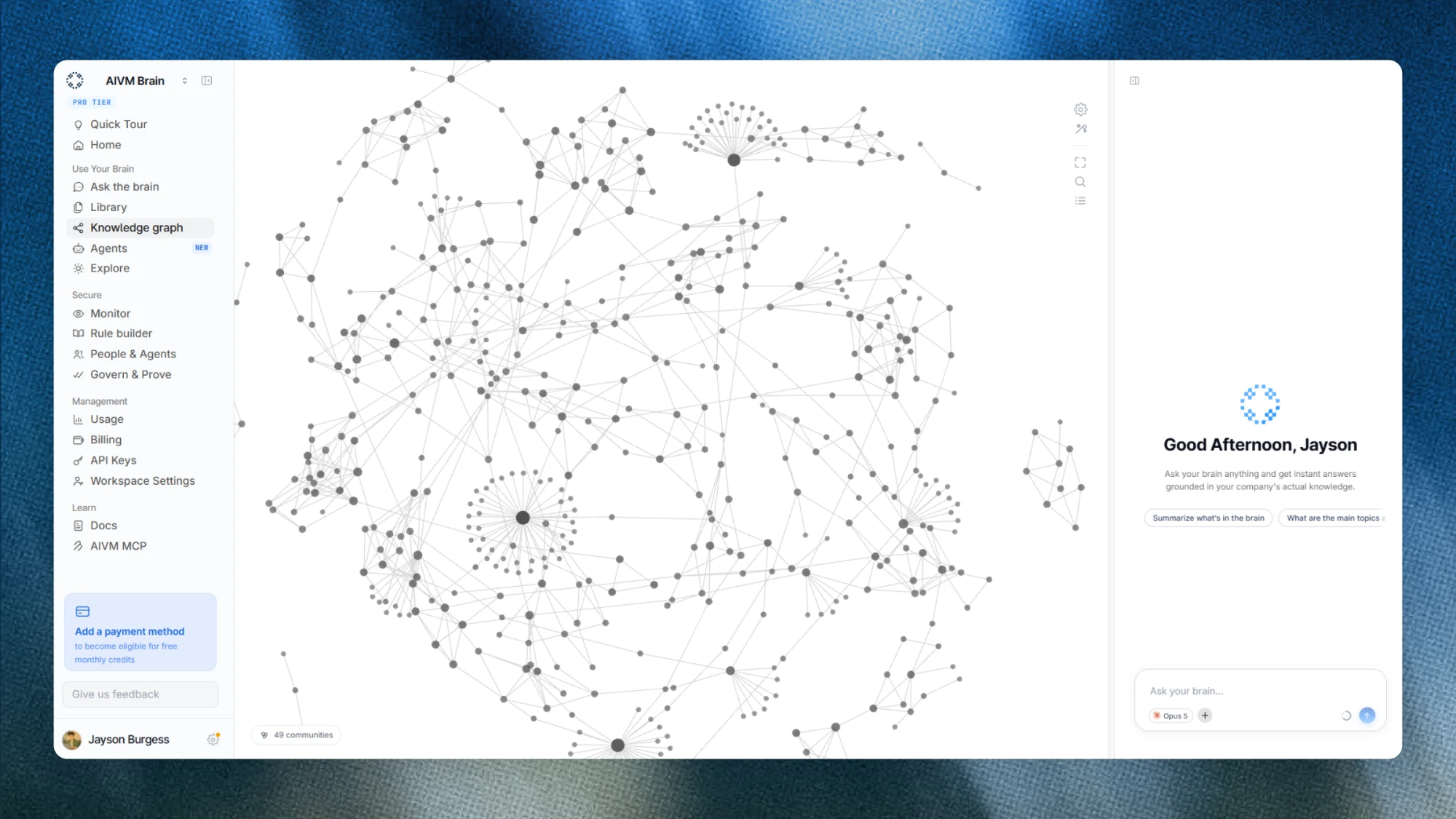
The launch presented a knowledge graph as one way to explore relationships between pieces of company information. The screenshot below records that interface. A graph can help someone navigate related material; its appearance does not prove that every relationship is correct or that every answer is supported.
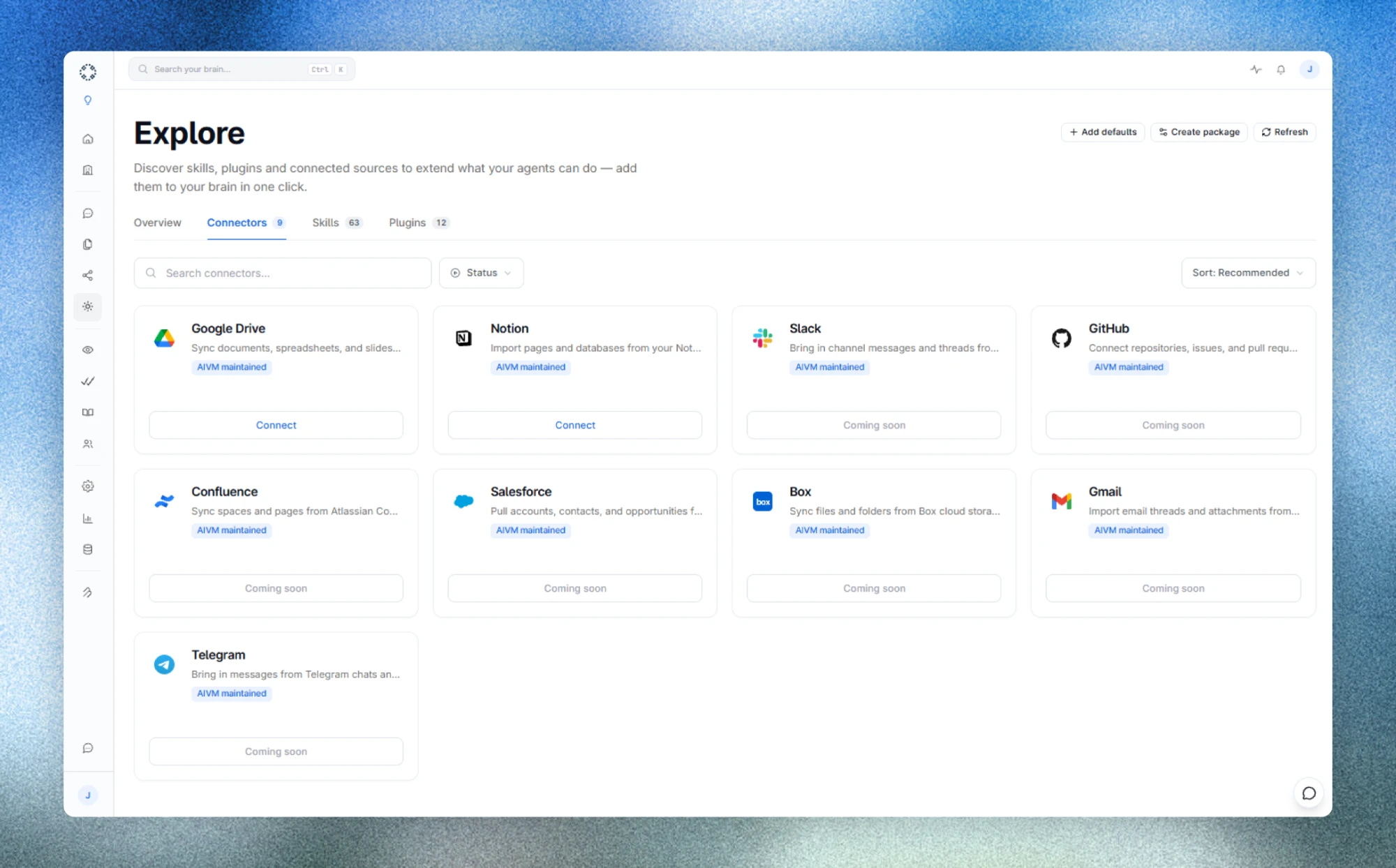
The connector catalogue also showed the intended direction: bringing company sources into an AI workflow. In the historical image, Google Drive and Notion have Connect buttons. The other visible entries are marked Coming soon. Those labels describe the screenshot, not a verified list of currently working integrations.
A concrete way to judge the idea
Here is a fictional example of the reader problem, not a demonstration of tested HeyBrain behaviour. A project folder contains Plan A: “Release on November 4,” followed by Decision B: “Move the release to November 11 because the import review is incomplete.” Someone asks, “What date belongs in this week’s update?”
A useful answer is: “Use November 11. Decision B replaces the earlier November 4 plan because the import review is incomplete.” The answer should point to Decision B. If the folder also contains an undated note saying “Maybe November 18,” that proposal should not silently become the approved date.
This example separates three jobs: keep the source decision, find it when asked, and explain its relationship to the older plan. Editing the original plan is a fourth job. An answer that retrieves a decision has not necessarily written a change back to the source system.
Reading the announcement today
The original launch described ambitions around shared context, access controls, connected AI tools and usage visibility. A dated announcement cannot establish the present scope of any of those capabilities. The screenshots also cannot establish permission behaviour, update speed, or whether a particular AI client can read or write a particular source.
For current offers, consult the pricing page and the options available in your workspace. For a small evaluation, choose one current decision and one superseded version, then inspect the answer and its source. The shared-context pilot guide explains how to define that exercise without assuming a particular connector or a fixed setup time.
The lasting idea behind the launch is straightforward: people should be able to reuse company knowledge without reconstructing it from scratch in every conversation. The useful test is whether the next teammate can find the right decision and understand why it applies.